
The CRC ‘Catalysis at Liquid Interfaces (CLINT)‘ followed a new paradigm: We aimed to explore the highly dynamic, anisotropic environment of liquid interfaces to create, tailor, and stabilise catalytically active sites with unique reactivity and performance. With this concept, we addressed fundamental problems of catalyst science and technology and aimed to develop novel catalytic materials that combine selectivity, productivity, robustness, and ease of processing at the highest possible level. CLINT consisted of four strongly interlinked research areas, all dealing with solid-supported liquids of ultralow vapour pressure to enable stable catalytic performance in continuous gas-phase reactions.
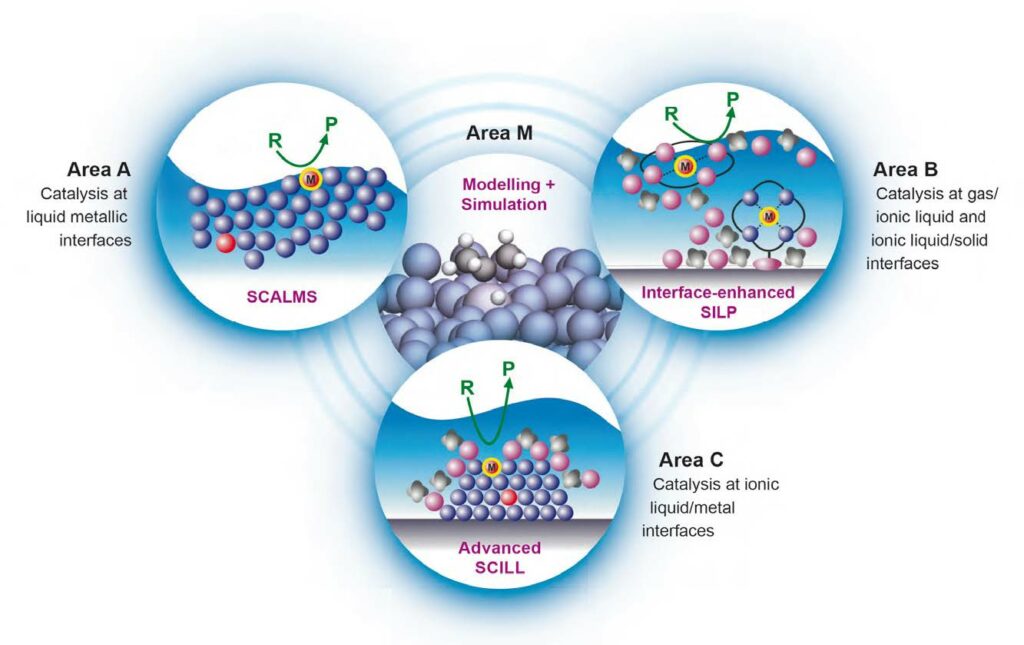
Area A SCALMS investigated the dynamic formation of supported liquid alloy interfaces in the presence of reactive gases, representing a new, technically relevant route towards heterogeneous single atom catalysts. The concept of Supported Catalytically Active Liquid Metal Solutions (SCALMS) was explored systematically towards optimised materials properties and enhanced performance. We aimed to develop SCALMS into a fundamentally understood and scalable approach for dehydrogenation and C-C coupling reactions.
Area B Interface-enhanced SILP also aimed at creating single catalytic sites at liquid interfaces. Here, we focussed on dissolved molecular catalyst complexes that show a very high preference to be located at the interfaces of Supported Ionic Liquid Phase (SILP) systems. The interface affinity is a function of the applied ligands, the support chemistry, the IL, and the chemical potentials in the gas phase. Our research target was to elucidate and exploit the specific reactivity at both the gas/liquid and the liquid/solid interface.
Area C Advanced SCILL dealt with dynamic interactions at the reactive interface between ILs and catalytically active metals. We aimed to expand the approach of Solid Catalysts with Ionic Liquid Layer (SCILL), which is based on the modification of supported metal catalysts by ILs, by taking advantage of the chemical versatility of functionalised ILs and applying the concept to novel (electro)catalytic transformations.
The Areas A, B, and C were tightly interlinked by overarching aspects: Wetting, selective interaction, mobility, segregation, ligand/ensemble effects, anisotropy of reactive environments, and interfacial field effects. To bridge between a detailed understanding of these aspects and the development of new materials, each area comprised fundamental studies on model systems, investigations on real catalysts, and in situ and operando characterisation. Area M Modelling and Simulation addressed these joint aspects by theoretical studies on the electronic structure of liquid interfaces, the distributions of active sites, the dynamics of self-organisation, and the structure formation at the interface. In this way, we developed a comprehensive approach to the new concept of catalysis at liquid interfaces.